African Villages Water & Sanitation Project – Global Grant 2025
Concept Statement
Global Grant # 2578440
A partnership between the Rotary Club of Tehachapi, CA, the Rotary Club of Kericho, Kenya and Global Water Works (non-profit corporation 501c (3)).
Summary
This Global Grant initiative aligns with Rotary’s Area of Focus: Water and Sanitation Hygiene platform.
This project supports 12 villages having nearly 4,800 people comprising of vulnerable youth, rural women, and persons with disabilities, through initiatives designed to improve their long-term health and well-being, economic stability, and community pride. By implementing a Rainwater Harvest System (RWHS) we can manage and sustain meaningful change for the villagers in Bomet County.
Brief Description
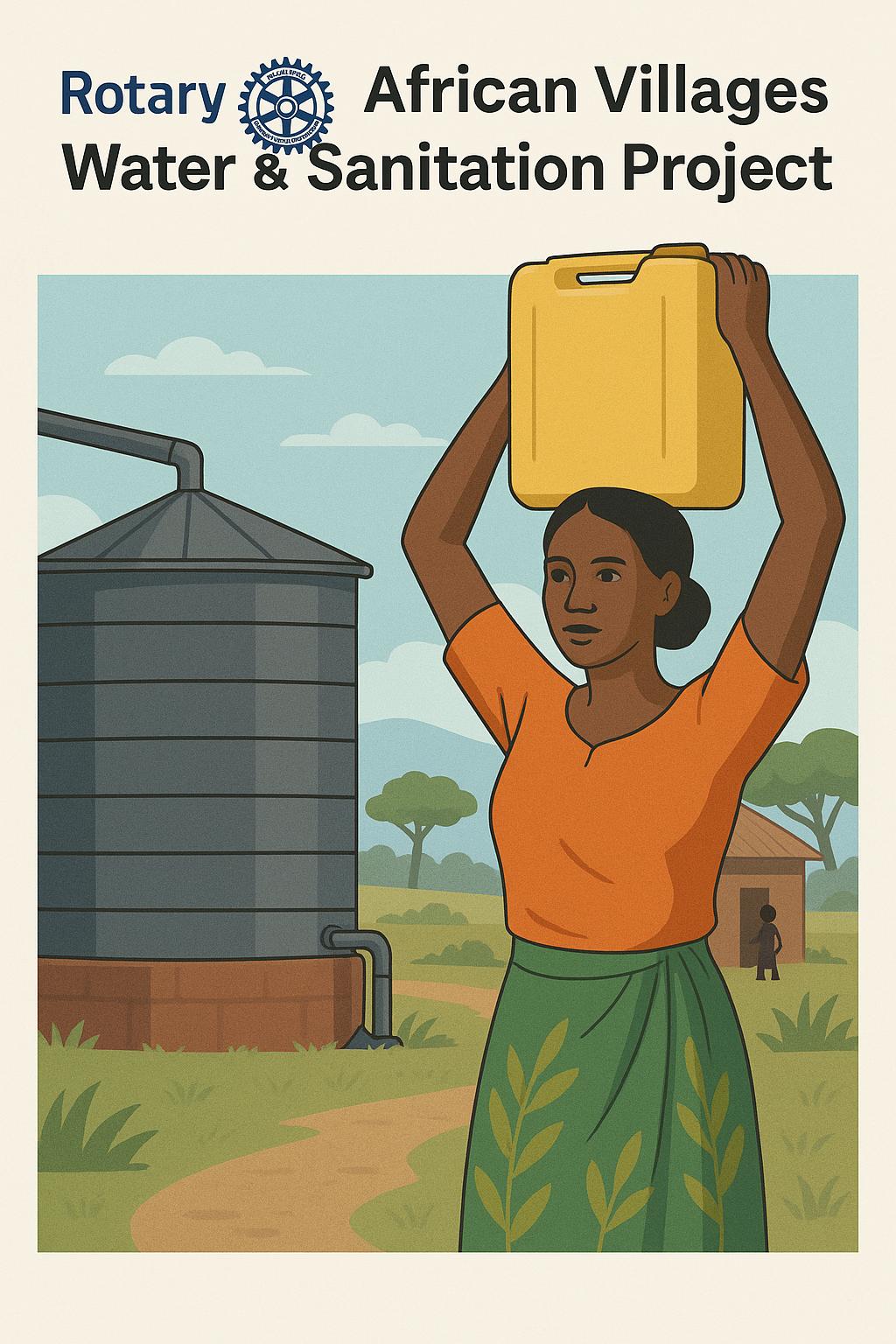
The people living in Bomet County in Kenya are faced with the challenge of no access to clean water for drinking and for domestic use. Certain areas of Kenya have significant rainfall for 7 to 9 months a year but this water is mismanaged and allowed to runoff into roads and stagnant ponds. The villagers are faced with the task to collect small amounts of contaminated water by walking 5 or 6 kilometers several times each day. This task requires many people mostly women and young children to supply water to the village.
These Villages have no electricity or plumbing system to collect and store water for daily use. There are no facilities to promote sanitation and personal hygiene. The local government is unable to assist these villages with any type of utilities, solar arrays or water collection systems.
The challenge is not lack of WATER but the infrastructure to passively collect abundant rainwater for personal use, cash crop farms and to store sufficient water for future use during periods of no rainfall or even drought that occurs over time.
A RWHS benefits all people of the village by allowing women to earn income, children to achieve an education, reduce illness and death caused by water-borne bacteria and diseases. Access to clean water is the foundation that promotes education, income growth, healthier lives and community unity.
Key Project Components
This project will include the following major activities:
- Activity 1 –Acquired ARSCA approval to use their guidelines and documentation for purposes of training local villagers in implementing, constructing and maintaining a passive RWHS.
- Activity 2 – Prepare instruction manuals to teach leaders how to change personal behavior towards hygiene and sanitation.
Activity 3 – Provide mentoring to villagers, access to capital, collection site improvements, conservation awareness campaigns, etc.
Project Duration
Estimated timeline: Implementation of the 12 RWHS projects begins November 2025 through March 2026.
Budget
Estimated total cost: $76,700
A detailed budget is available upon request.
Long-Term Goal
This initiative aims to create lasting impact by equipping participants to earn income, improving access to education, healthcare, and community unity.
Success will be measured through number of participants trained, incomes secured, access to education and community health improved.
If successful, this pilot project may serve as the foundation for a future project or similar expansion to implemented RWHS sites in Kenya.
For More Information or Club Engagement
If your club is interested in a presentation or a Zoom discussion about this initiative, please contact:
Gerard (Jerry) Munson ISC Chair Rotary Club of Tehachapi
Email: gfmunson@aol.com
Cell#: 661 645 3048